Most homeowners assume they know where their property ends. They point to a fence, a tree line, or an old metal pin in the ground. But in many cases, those reference points are wrong, moved, or not legal proof of anything.
If you want to find your property lines the right way, you need to know which tools are available, what each one can and cannot tell you, and when a physical marker is simply not enough to protect you.
What Are Property Lines?
Property lines are the legal borders that separate one piece of land from another. They show where your property ends and your neighbor’s begins. In Missouri, property lines are set by recorded deeds, subdivision plats, and licensed land surveys.
4 Ways to Find Your Property Lines
1. Read Your Property Deed
Your deed is the legal document that describes your land. It contains a written description of your property’s boundaries.
In St. Louis, older city lots often use a system called metes and bounds. This describes boundaries using directions and distances. Newer suburbs typically use a lot and block system, which refers to a recorded plat map.
You can get your deed from:
- St. Louis City Recorder of Deeds
- St. Louis County Assessor’s Office
- Your title company’s closing documents
A deed describes your property in words. It does not show you exactly where the line falls on the ground.
2. Look Up Your Plat Map
A plat map is a drawing of a subdivision. It shows each lot, its shape, and its size. Most homes have a plat on file.
You can find plat maps through:
- St. Louis County GIS portal
- Missouri Spatial Data Information Service at msdis.missouri.edu
- Your county recorder’s office
Plat maps give you a good picture of your lot. But they show what boundaries should look like on paper, not exactly where they fall on your land.
3. Use a GIS Parcel Viewer Online
GIS tools let you view property boundaries on a satellite map. Free options for St. Louis residents include the St. Louis County GIS parcel viewer,Regrid.com, and MSDIS.
These tools show lot lines and owner names. But GIS data comes from deeds and plats, not from field measurements. Lines can be off by several feet and carry no legal weight.
4. Search for Physical Property Markers
When a surveyor surveys a lot, they place physical markers at the corners. Finding these markers is the most hands-on way to locate your lines.
Common marker types:
| Marker Type | What It Looks Like | Reliability |
| Iron pin or rebar | Thin steel rod in the ground | Moderate |
| Iron pipe | Galvanized pipe, sometimes capped | Moderate |
| Concrete monument | Large post, sometimes with a brass cap | High |
| Plastic cap on rebar | Cap stamped with the surveyor’s license number | High when intact |
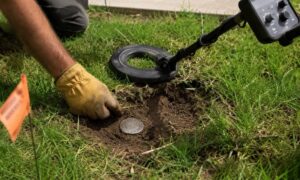
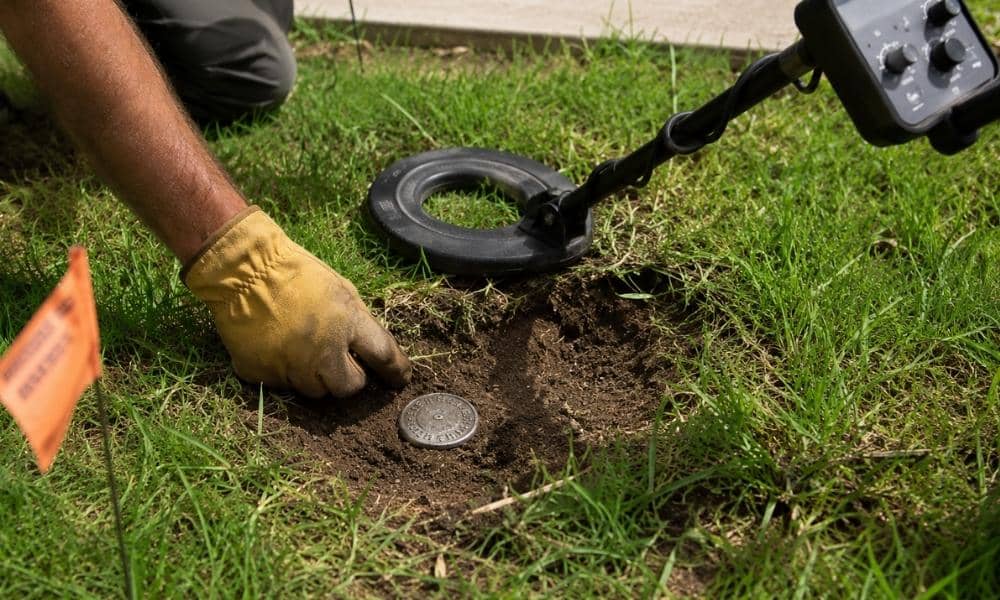
Look at lot corners, near the front curb, and along shared lines. Markers are often buried 2 to 6 inches underground. A metal detector or magnetic locator can help.
Markers can be moved by landscaping, grading, or construction. Finding one does not mean it is still in the right place.
When Markers Are Not Enough
Property line markers are not legally reliable when they have been moved, damaged, or lost. In Missouri, only a licensed land surveyor can produce a boundary result that holds up in court, in permit applications, and in real estate transactions.
Here are the situations where you need more than a marker:
- You are building a fence, deck, or addition. Most St. Louis municipalities require survey documents before issuing a permit.
- A neighbor is challenging your boundary. A marker you found in your yard has no legal standing on its own.
- Markers are missing or visibly disturbed. If a pin is bent, shifted, or gone, it cannot be trusted without professional confirmation.
- You are buying or selling land. Title companies in Missouri often require boundary confirmation for vacant lots and larger parcels.
- Your property is older than 40 years. Older St. Louis lots were often measured with methods far less precise than today’s GPS surveys.
According to the American Land Title Association (ALTA), about 1 in 4 real estate transactions involves a boundary issue, encroachment, or easement problem that a standard title search will not catch.
What a Licensed Land Surveyor Does
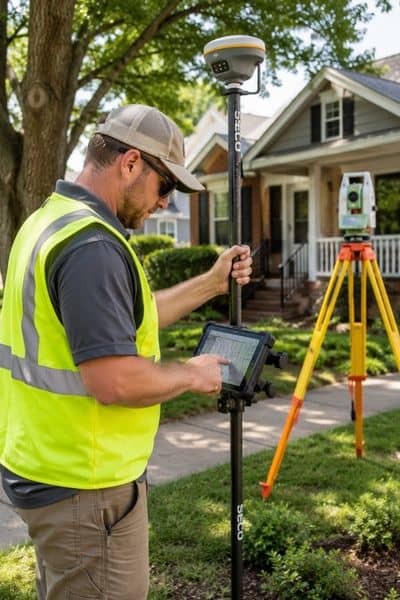
A licensed land surveyor researches your deed and plat records, takes physical field measurements, and places new monuments where needed. Their findings are legally binding and accepted by courts, permit offices, and lenders.
The process works like this:
- The surveyor pulls your deed, plat, and past surveys from public records.
- They visit your property and measure from known points using GPS and survey instruments.
- They compare field measurements to recorded data and resolve any differences.
- They place new iron pins or concrete monuments at lot corners.
- They prepare a plat of survey, a signed document that becomes part of your legal record.
In Missouri, only a person with a Professional Land Surveyor (PLS) license can certify a boundary survey. This is required under Missouri Revised Statutes Section 327.272.
How Much Does a Property Line Survey Cost?
A standard property line survey typically costs between $500 and $1,500 for a residential lot. Larger lots, complex terrain, and missing original monuments will increase the price.
| Survey Type | Typical Cost |
| Property line / boundary survey | $500 to $1,500 |
| Full residential lot survey | $700 to $2,000 |
| Topographic survey | $1,000 to $3,500 |
| ALTA/NSPS land title survey | $2,000 to $6,000+ |
| Elevation certificate | $300 to $700 |
The National Society of Professional Surveyors (NSPS) reports that survey costs rose 15 to 20 percent across major metro markets between 2021 and 2024, driven by construction demand and rising labor costs.
Frequently Asked Questions
Can I find my property lines for free?
Yes, in part. Deed records, plat maps, and GIS tools are free through St. Louis County and City offices. But these only give you approximate information. For a legally binding result, you need a licensed land surveyor.
Can a neighbor legally remove my property marker?
No. Under Missouri Revised Statutes Section 60.290, removing a survey monument is a Class A misdemeanor. If you think a marker was removed on purpose, document it and contact a surveyor and an attorney.
Do I need a survey to install a fence?
Most municipalities require survey documentation before issuing a fence permit. Check with your local planning and zoning office first.