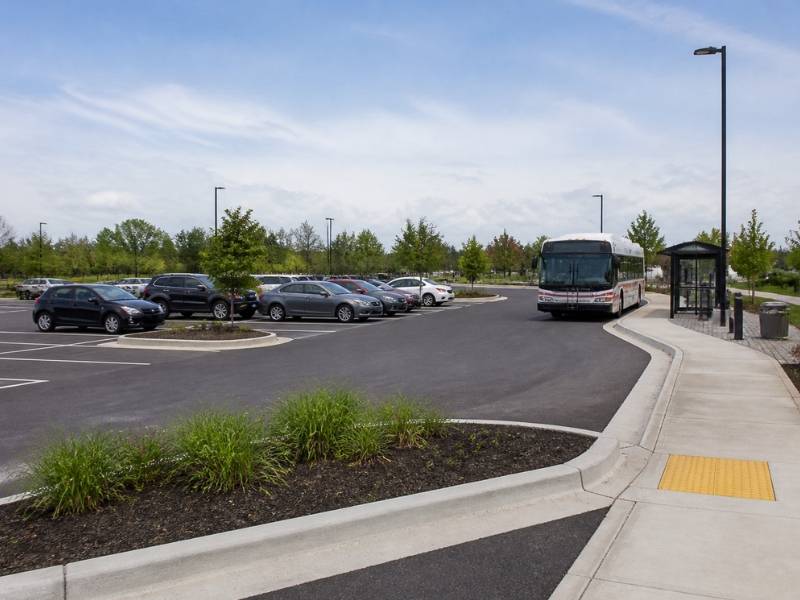
A park-and-ride lot has to work for drivers, bus operators, and people on foot, often within a few hundred feet of each other. Small layout errors show up fast on that kind of site. A loading curb set a few inches off, or a parking field that drains toward the platform, can lead to rework, delayed openings, and failed inspections.
That’s why survey work runs through the whole build, not just the first week. A construction survey ties the design to the ground, guides each phase of layout, and checks the results before pavement and concrete are locked in. Owners, engineers, and contractors who plan that work early keep the project closer to schedule and budget.
Construction Survey Control for Parking Lot Layout and Grading
Survey control is a network of fixed points with known coordinates and elevations. Every stake on the site is set from those points, so they need to be accurate, stable, and protected. On a large paved site, control usually sits around the perimeter where traffic and equipment won’t disturb it.
Once control is in place, the crew stakes the parking field, curb lines, islands, and light pole bases. Grade stakes show cut and fill so the earthwork contractor can shape the subgrade. Many contractors use machine control on grading equipment, and those systems depend on the same control network and a checked surface model.
Ask the survey team to verify control before each major phase. Points can get bumped, buried, or knocked out by equipment. Catching a disturbed point early costs far less than regrading a section of the lot.
Bus Circulation Lanes and Passenger Loading Zone Alignment
Buses need more room than cars, and they don’t forgive tight geometry. Circulation lanes, curb returns, and turning radii are designed around the vehicles the transit agency runs. If a curb is staked a little inside the design line, a bus may clip it or swing into the opposing lane.
The survey crew stakes lane edges, centerlines, and curb returns, then sets offsets so the curb crew can build to them. Loading zones get extra attention. Boarding curbs often have specific height and alignment requirements set by the transit agency, so the stakes have to match the plans closely.
Confirm the agency’s design standards before layout begins. Requirements can vary by agency, vehicle type, and project scope. It also helps to walk the bus path with the contractor once curbs are formed and before concrete is placed.
Elevation Transitions Between Parking Areas and Transit Platforms
The spot where a parking lot meets a transit platform is one of the trickiest areas on the site. Walking paths have to meet accessibility slope limits, while the platform has to sit at the right height for boarding. Water also has to drain away from where people stand and wait.
Surveyors stake these transitions with tight elevation checks. Spot grades at ramps, crosswalks, and platform edges help confirm the design works in the field. If existing conditions differ from the design surface, the crew can flag the conflict before forms go up.
Short distances make errors costly here. A small elevation miss across a few feet can push a ramp or walkway past its allowed slope. Checking forms before each pour is one of the cheapest steps on the whole project.
Construction Survey Checks for Drainage Structures and Utility Placement
Large paved areas move a lot of stormwater, so inlets, pipes, and detention features have to be built right. Surveyors stake structure locations and set inverts, which are the bottom elevations of pipes at each structure. A pipe laid with too little slope can hold water and fail to drain the lot.
Utilities follow the same process. Lighting conduit, electrical service, fare equipment, shelters, and water lines all need staked locations. Many projects also call for survey checks of pipes and structures before backfill, so the as-built record matches what’s actually in the ground.
Ask the contractor and engineer which items need checks before they’re covered. Requirements vary by owner, permit, and project scope. Once trenches are backfilled and paved, fixing a missed error gets expensive.
Final Site Measurements for Pavement Limits and Accessible Routes
Near the end of the job, the survey team measures what was actually built. That usually includes pavement edges, curb lines, striping, structure locations, and finished grades. These measurements feed the as-built survey, which compares the finished site to the approved plans.
Accessible routes get close review at this stage. Under the ADA Standards, accessible walking surfaces generally have a maximum cross slope of 1:48, and a running slope steeper than 1:20 is treated as a ramp with its own rules. Project specs and local reviewers may add requirements, so confirm what the owner expects at final inspection.
Final measurements protect the owner later too. They document pavement limits for maintenance, show where utilities and structures sit, and support closeout paperwork. Keep the as-built files with the permanent project records.
Frequently Asked Questions
What does survey layout include on a park-and-ride project?
It usually includes control setup, grading stakes, curb and lane layout, drainage structure staking, and utility locations. Crews also run checks before concrete pours and backfill. Near the end, they measure finished work for as-built records. The exact scope depends on the contract and the owner’s requirements.
Who usually hires the survey team for a transit parking site?
It depends on the contract. Sometimes the owner or transit agency provides control and the contractor handles daily layout. Other projects put all survey work under the contractor. Check the contract documents early so nothing falls through the gaps.
Can machine control replace survey staking?
Machine control can cut down the number of stakes needed for grading. It still relies on accurate control points and a checked design model. Curbs, structures, and utilities usually still need staking or field checks. Talk with your surveyor about which items can go without stakes.
How often should control points be checked?
Check them before each major phase and any time they might have been disturbed. Heavy equipment, frost, and soft ground can shift points. Many crews also tie in backup points as a safeguard. Regular checks cost little compared with rework.
When should survey work be scheduled on a park-and-ride project?
Bring the survey team in before mobilization. Control needs to be set and verified before earthwork starts. Staking for curbs, drainage, and utilities then follows the construction sequence. Early scheduling keeps crews from waiting on layout.